Tune your detection rules, adjust your alert thresholds, run periodic tests… If you’re looking to optimize your SIEM, you’ve probably come across this and similar advice. And while all of this is undoubtedly good practice, there’s a more fundamental issue at play in most SIEM optimization situations: a SIEM is only as good as the data that feeds it.
A security data pipeline like Realm Security can immediately optimize any SIEM by streamlining how telemetry moves through your environment and improving data quality. The result is lower operational overhead and cost. A SIEM optimized with Realm Security can cut costs by over $250K while giving its owners faster, more accurate detection and response.
Our experience is that when organizations get the data layer right, the SIEM they already have in place starts doing what they bought it to do. Below are seven ways to make that happen.
1. Optimize your SIEM by filtering out noise
Cut volume going in — saving $$$ and reducing analyst fatigue.
“Ingest everything” is the default in 42% of SOCs. Yet only 35% of the data sitting in legacy SIEMs is actually useful for detection.
The other 65% (usually routine, low-value telemetry like DNS queries, heartbeat signals, and firewall-allow events) gets indexed at premium rates without ever helping a single investigation.
The result is a large SIEM bill, of course, but also bloated indexes, slower searches during investigations, and anomaly detections that fire as false positives. Downstream of this, analysts spend their time investigating alerts that turn out to be nothing.
The solution is obviously to filter out the noise.
If only filtering data were that simple! Experienced practitioners know well that determining which logs are worth keeping vs. which aren’t is not easy.
Cut the wrong log, and you could inadvertently break a detection rule that depended on those events, or lose visibility you didn’t know you needed, sometimes without realizing it’s gone until it’s too late.
How Realm Security filters out noisy logs
Realm Security’s AI-native engine analyzes each connected source, identifies the highest-volume and lowest-value categories, and generates filtering recommendations automatically.
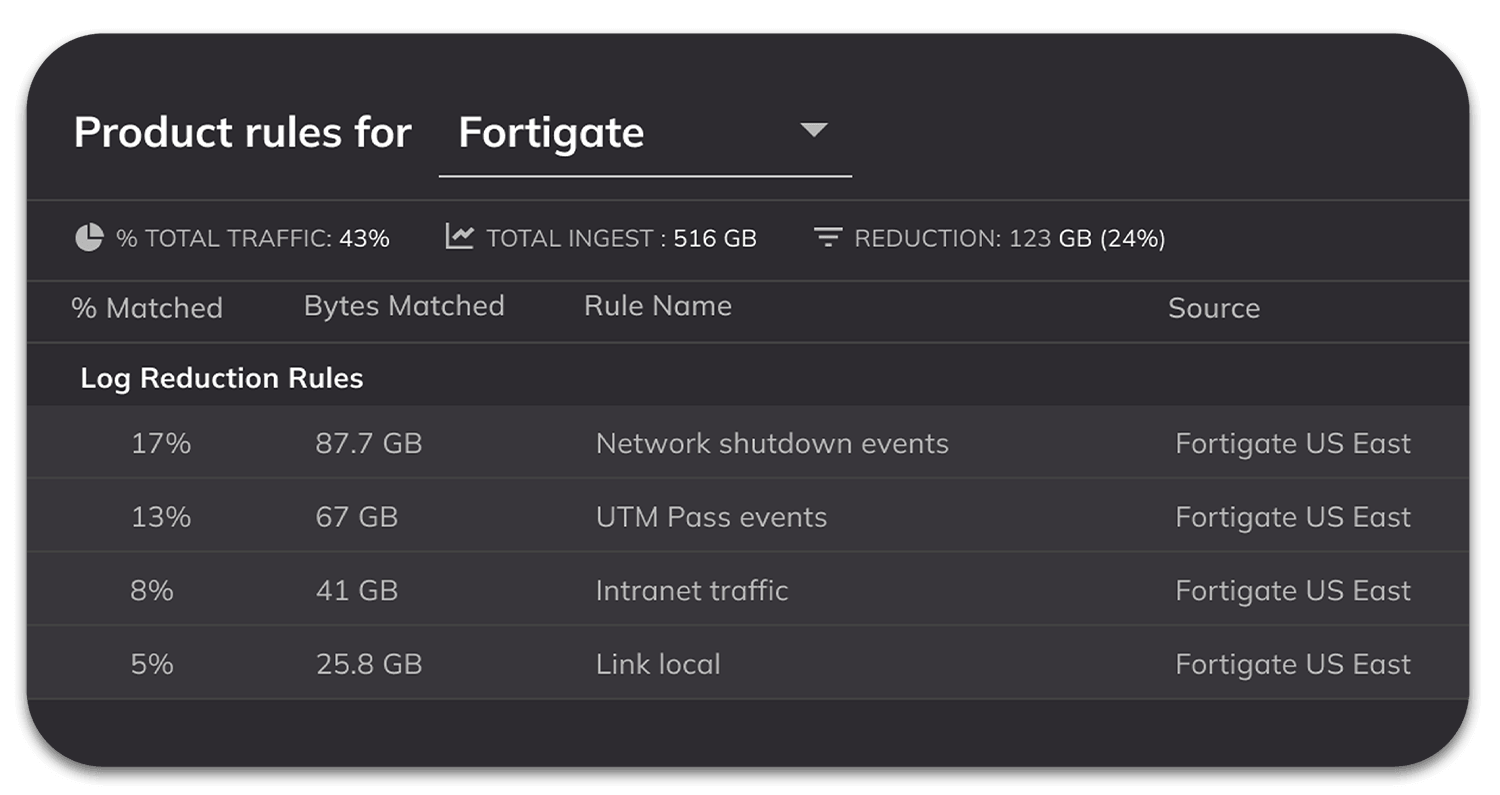
Every recommendation comes with an explanation of why removing the data won’t impact detection or incident response in a negative way. The analyst’s job changes from building rules to reviewing and approving them, which means more time for actual security work.
Before any rule ships, Realm Security cross-checks it against a library of SIEM detection rules across products. If a known detection rule downstream needs those events, the recommendation doesn’t ship.
Additionally, every rule ships in a Staging mode that evaluates it against live log flow without affecting production, so you get to see the volume impact and confirm the rule does what it’s supposed to do before promoting it.
Since Realm Security filters by removing events rather than modifying them, the full original event with all of its fields flows into the SIEM. Existing detection content keeps firing.
HR services provider Vensure optimized their Sumo Logic deployment by using Realm Security to cut FortiGate firewall log volume by 83%, saving $254K annually, while fully preserving denied connections, unusual port activity, and policy violations.
2. Normalize data before the SIEM, not inside it
Ensure consistency for detection.
SIEMs work best when fields are consistent across sources.
Security practitioners interviewed for the November 2025 SACR Security Data Pipeline Platform Market Report called consistent schemas “the precondition for any mature detection or analytics program,” and noted that when normalization is right at the start, vendor content and correlation logic across the stack work as designed.
Without that consistency, SACR’s report says every downstream tool suffers, including SIEM, XDR, SOAR, UEBA, AI SOC, and the detection content built on top of them.
Normalizing upstream into open schemas like OCSF or ECS solves this, and because the same normalized stream can be routed to multiple destinations, the work doesn’t need to be repeated for each tool.
How Realm Security normalizes data before the SIEM
Realm Unity uses machine learning to normalize logs from any connected source into standards like OCSF and ECS automatically.
Outbound, Realm Security maps events to the format each destination SIEM’s native parsers expect, so existing parsing and detection logic keeps working without re-engineering.
Once telemetry is normalized, it can be queried and routed to multiple destinations (SIEM, XDR, data lake, archive) without re-mapping.
3. Enrich data before the SIEM
Richer detections and faster triage.
Raw security events don’t carry the context analysts need, so they often spend considerable time pivoting between tools to assemble it instead of focusing on the decision the alert is actually asking them to make.
It’s not just analyst time that is wasted in this scenario, either. Enriching inside the SIEM or data lake means repeated lookup queries and JOIN operations, which can also significantly inflate compute costs.
How Realm Security enriches data before the SIEM
Realm Data Enrichments add useful context to your log data while it’s flowing through the security data pipeline, before it reaches your SIEM.
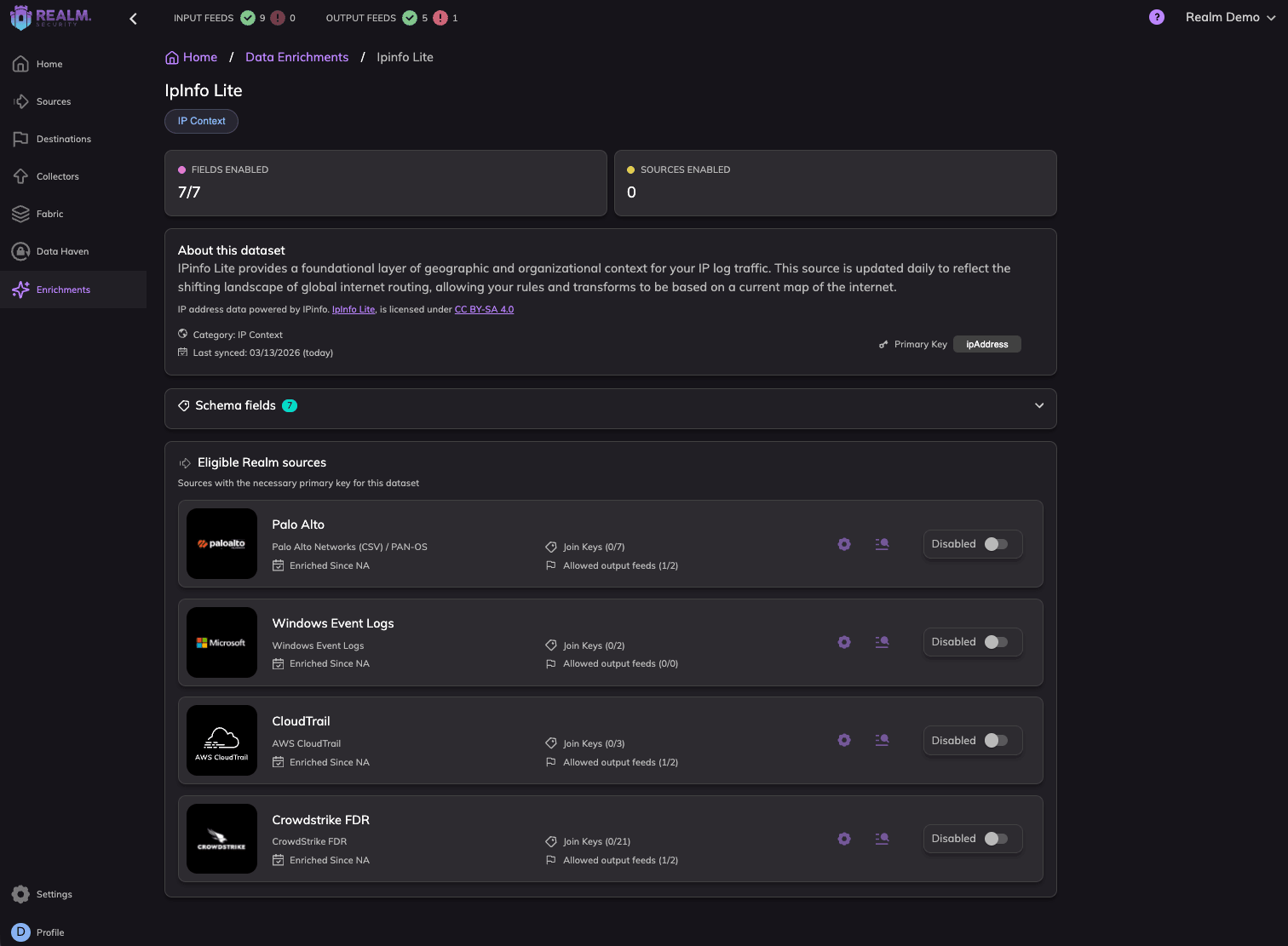
For IP addresses, this works in two ways.
The first is contextual. We attach the IPs’ geographic location, ISP ownership, and network intelligence, drawn from providers such as MaxMind and IPinfo. This gives analysts the background they need to evaluate an alert.
The second is a security check against threat intelligence feeds, triggering a detection before the SIEM has even indexed the event. The result is faster detection of known threats and less work downstream.
4. Stop silent log dropouts and schema drift before they create coverage gaps
Stay on top of telemetry health.
Excessive SIEM alerts are a problem, but missing telemetry may be even worse.
If log sources stop forwarding, vendors push schema changes, and destinations throttle, events can stop arriving or arrive in a state the SIEM can’t use, but the SIEM dashboard still looks healthy because the events that did arrive look normal.
Noticing this without a pipeline layer becomes the SOC team’s responsibility, which usually means configuring silent dropout thresholds per source in the SIEM, accepting data loss when SIEMs throttle or hit license caps, and rewriting parsers every time a vendor changes a log format.
How Realm Security monitors telemetry health
Realm Security builds a behavioral baseline of normal data flow on every integration so that when a source deviates from its baseline (for example, there’s a sudden volume drop), it can flag it without your team having to configure any manual thresholds.
If, for whatever reason, a destination becomes unreachable, Realm Security holds the incoming data in a queue for up to 14 days instead of dropping it. As soon as the destination is back online, the queued data flows through automatically, with no manual catch-up needed.
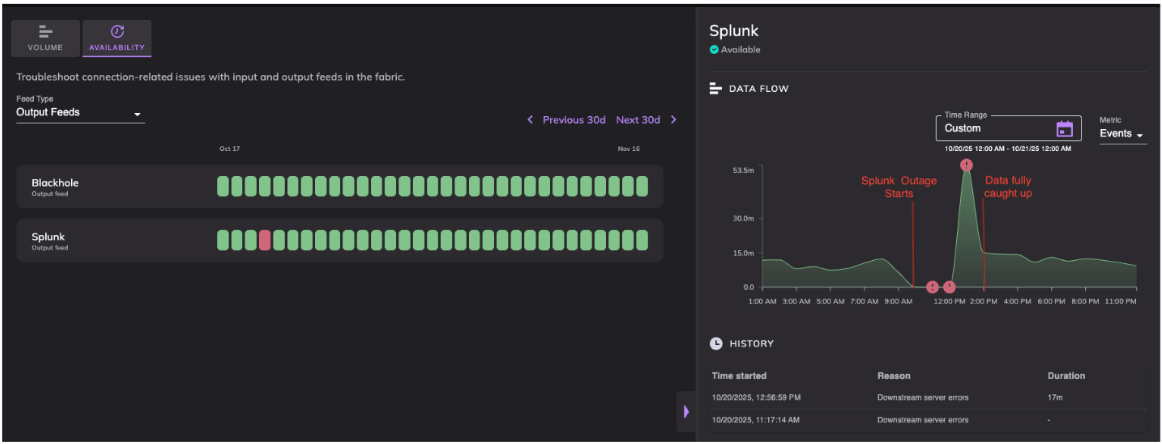
Under normal conditions, data moves through the pipeline in milliseconds and never takes longer than 30 seconds end-to-end. That means detections are always running on current data, not a backlog.
5. Match data to destination
Keep the SIEM fast at what it’s built for.
Most teams run into the same dilemma when it comes to historical data. Either:
- Keep it in the SIEM at full license cost. Searchable when you need it, but expensive enough that most teams can’t afford to retain everything they should.
- Send it to cold storage. Cheap, but effectively out of reach during an investigation. That’s a real problem when IBM’s 2025 Cost of a Data Breach Report puts the average time to identify and contain a breach at 241 days. By the time you know you need the data, retrieving it from cold storage can take days or weeks.
The obvious, cost-saving workaround is moving older, less-frequently-accessed logs out of the SIEM and into cheaper storage tiers from the major providers like AWS or Azure. At least on paper, this can cut storage costs in a big way (cold tiers are much cheaper compared to SIEM rates).
In reality, while storing logs yourself is cheap, using them alongside your SIEM can be clunky. Integrating data from the SIEM with data in other storage locations is cumbersome, which often leaves teams building their own connectors, maintaining them as systems evolve, and writing custom queries to pull data back for investigations.
Waiting two to four weeks to query archived data isn’t unusual. And if you add unpredictable retrieval charges and billing no one fully understands, the self-managed archive can quickly become more hassle than it’s worth.
Unsurprisingly, many teams end up giving up and routing logs back into the SIEM as a de facto archive, accepting the cost rather than living with the operational pain.
What teams actually want is a system with tiered storage where some data stays hot for active detection, some rolls warm, some archives cold, but also with rehydration paths when investigations call for it.
How Realm Security routes data to the right destination
Realm Security routes data to multiple destinations at once with no source reconfiguration. High-signal detection data goes to your SIEM. Everything else (hunting, forensics, compliance telemetry) flows in parallel to Realm Data Haven.
Data Haven is where most of your telemetry should live. It’s a hosted retention tier that sits next to your SIEM, deploys with zero configuration, and holds a full year of raw data by default (up to five years for compliance).
What makes it different is what happens when an analyst needs that data back. A guided resupply workflow scopes the request by user, IP, hostname, or other dimensions, then streams the relevant slice into a specific SIEM index in minutes. No query language. No re-ingestion project. No waiting on the data team.
Resupply is fast because Realm normalizes and tags telemetry with OCSF-aligned IOC fields at ingest. Logs come out of Data Haven already structured for analysis.
As an example, say a SOC analyst sees a suspicious C2 beaconing attempt and needs to know if the same IP appeared anywhere in the environment 90 days ago. The old way would involve them filing a ticket with the data team, waiting several days, and getting back a 50 GB CSV that does not load cleanly into the SIEM.
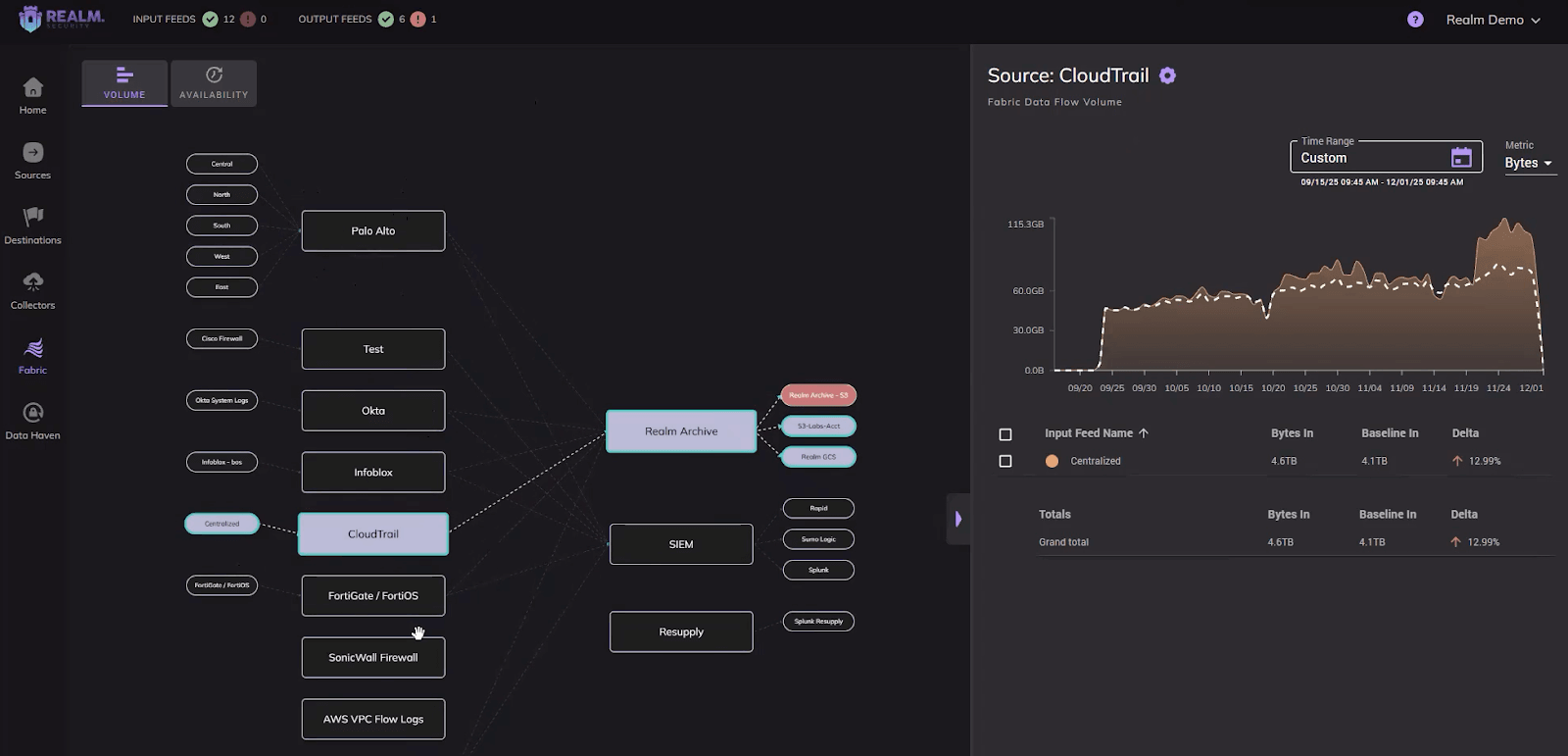
With Realm Security, you can just enter the IP in Data Haven, select a 90-day window, click resupply, and watch the relevant 200 KB stream into the analyst’s active SIEM index in minutes. Mean Time to Remediate significantly drops because the analyst is not waiting on data tickets.
6. Close the coverage gaps regulated data creates
Stay compliant without losing visibility.
Important logs often don’t make it into your SIEM.
Logs containing PHI, PII, payment data, and other regulated fields routinely get left out of SIEMs hosted in third-party cloud platforms, because routing that data through someone else’s tenancy can itself be a compliance violation.
The compromise most organizations make is either to turn off specific log fields or to stop ingesting the source altogether.
That trade-off comes with a cost, though. No amount of in-SIEM rule tuning can close a coverage gap created at ingestion, because the events the detections need never reach the SIEM in the first place. If an incident involves one of these excluded sources, the investigation starts with missing context.
How Realm Security makes restricted sources safe to ingest
Realm Privacy Guard sits between your data sources and your SIEM, scanning for sensitive information as it flows through. Things like names, addresses, secrets, tokens, and API keys are redacted before the data reaches the analytics layer, whether they appear in structured fields or are buried inside unstructured log content.
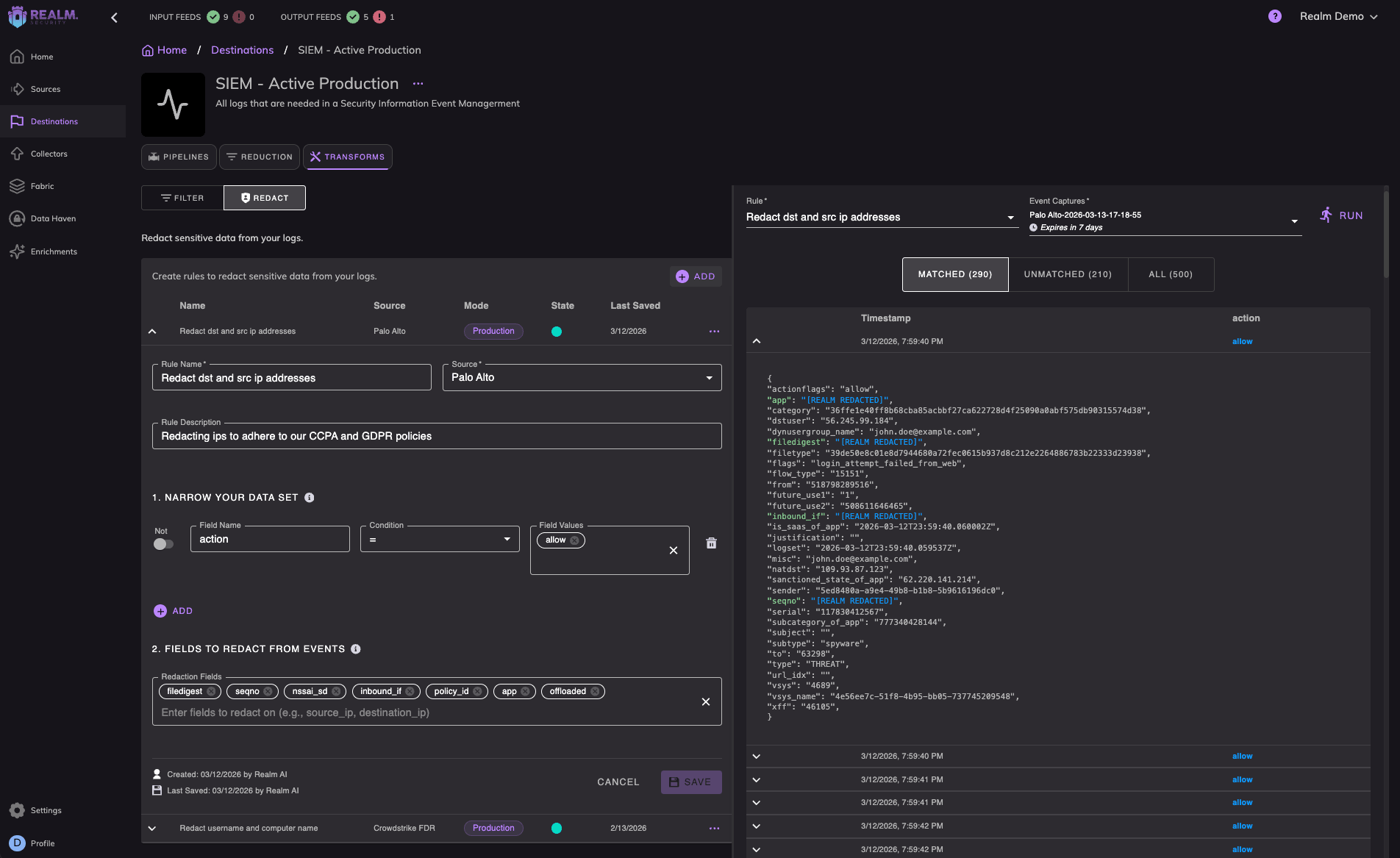
So, when an analyst looks at the logs in the SIEM, customer names and account numbers have already been redacted by Privacy Guard.
Privacy standards are configured per source, destination, or data location, so the same source can be redacted heavily for a SIEM hosted in one tenancy and forwarded clean to a forensic toolset hosted somewhere with different controls.
If an investigation needs the original unredacted data, an authorized user can pull the raw logs from Realm Data Haven into a separate SIEM index with its own access controls. The action is logged for audit, and the data can be purged once the investigation is finished.
7. Future-proof for the AI SOC
The data layer is the prerequisite.
Whether you’ve already incorporated AI into your SOC in some form or are planning to do so later this year or next, the same data preparation that helps you optimize your SIEM today also puts your team in a better position to adopt agentic and AI-assisted tooling without rework.
The data layer is the prerequisite. The data feeding your AI systems has to be high-quality, normalized, enriched, and complete.
The November 2025 SACR Security Data Pipeline Platform Market Report puts it bluntly:
“AI systems depend on high-quality, normalized, enriched, and complete data. Pipelines are becoming the preparation layer for AI copilots, LLM-based SOC assistants, advanced correlation engines, and autonomous triage. Without pipelines, AI performance degrades significantly.” — SACR Security Data Pipeline Platform Market Report, November 2025
How Realm makes your data ready for the AI SOC
AI SOC tools are only as good as the data feeding them. Noisy, inconsistent, or incomplete telemetry produces unreliable agents and bad recommendations, no matter how capable the underlying model is.
The six things above are what make Realm’s data AI-ready: normalized schemas agents can actually parse, less noise to reason against, regulated sources that are now safe to include, and a retention layer built for machine querying.
When you plug an AI SOC tool into Realm, it gets clean, structured, complete data on day one.
See what Realm would do in your environment
SIEM optimization isn’t a one-time project. It’s a continuous discipline of getting the data layer right so the SIEM (and everything downstream of it) keeps doing what you bought it to do.
The 48-Hour Security Data Assessment shows you exactly how much SIEM cost you’d cut, what coverage you’d gain, and how your SOC’s day-to-day would change. No commitment, no rip-and-replace — just your data and a clear answer in two days.