TL;DR: SIEM log management is how you optimize log ingestion and routing so your SIEM works as well as possible. By default it happens inside the SIEM — which is expensive and can slow the SIEM down when it matters most. Doing it earlier, in a security data pipeline before the SIEM, means every log is normalized, filtered, protected, and routed in tiers, so only high-value data reaches the SIEM and everything else lands in cheaper, still-accessible storage. Realm Security automates all of it to make your SIEM cheaper to own and easier to run.
A SIEM is a security tool, and SIEM log management is the process of optimizing how log ingestion and routing happen to make a SIEM work as well as possible. By default, SIEM log management tends to happen inside the SIEM. Realm manages logs before the SIEM to cut SIEM costs and make your SIEM easier to own and run.
Why SIEM Log Management Matters

According to research by Sumo Logic, only 51% of SecOps leaders say their current SIEM is very effective at reducing mean time to detect and respond to threats. Our experience is that when you also bring cost into the conversation, only a small minority of security teams are truly happy with their SIEM.
Most organizations are sending too many logs directly to their SIEM, overburdening it with log management it was never built to do. SIEMs perform best when they receive only high-value data.
Say your organization uses an EDR tool like CrowdStrike Falcon or SentinelOne to verify the health of thousands of endpoints in real time. Only a small percentage of these logs have enough security value to be worth sending to the SIEM.
Instead of every log going straight to the SIEM, each one should be evaluated and then either:
- Routed to the SIEM for real-time threat detection.
- Sent to a “hot” indexed storage destination for fast queries.
- Sent to a cloud-hosted data lake (less expensive, but retrieval could take weeks).
- Discarded.
Using a data pipeline layer like Realm Security gives you a filter that sits between the data collected and your SIEM operations, so only security-relevant data is sent to the SIEM. Other data, when it’s useful for compliance or kept for future use, is stored in a way that keeps it consistent, rapidly accessible, and affordable.
This creates a highly cost-effective operation, yet still allows teams to pull related historical data back from storage when an incident happens, without noise or data degradation.
Why You Should Stop Doing Security Log Management (Exclusively) Inside Your SIEM
Log management centralizes, parses, and routes logs for general operational use. Most teams make the mistake of doing some or all of this log management too late in the data path, i.e., inside the SIEM itself.
Log management should (ideally) not happen only in the SIEM. When it does, the first thing it hurts is your security program’s budget. SIEMs are expensive, and storing increasing volumes of logs under SIEM vendor pricing agreements can result in multi-million-dollar storage cost overruns when storage destinations are mismatched.
It also hurts a SIEM’s performance, which, at some points in a SIEM’s life, can be one of the most business-critical parts of your security function. When an incident happens, rapid, accurate correlation in a SIEM can be the difference between fast MTTR and a multi-million-dollar business disruption.
Beyond these two high-level reasons, we see four more arguments for moving log management earlier in the data path, i.e., before the SIEM.
- Dealing with extended data breach timelines. Estimates vary, but it typically takes anywhere from several weeks to over a year for an organization to find and contain a breach. Log management data needs to perform roughly the same whether it was logged 12 months ago or an hour ago.
- Meeting current and future reporting requirements. Regulators are coming down harder on reporting timelines and requirements every year. As an example, PCI DSS now requires one year of retention (with three months readily available), plus specific fields in every record, like user ID, event type, timestamp, success or failure, origin, and affected resource.
- Responding to log volume growth. The basic idea of a SIEM is over 20 years old at this point, but never before have we seen this kind of increase in log volume. In some surveys, organizations report that log volumes grew by an average of 250% over the past 12 months.
- Adopting AI in your SIEM/SOC. In the organizations we talk to, we constantly hear about the pressure to bring AI into security operations. The big log management challenge here is that AI SIEM tools and features are only as good as the data that is input into them.
Only 35% of logs stored in SIEM environments are estimated to have detection value. The best SIEM log management workflows bring as few logs to the SIEM as possible without compromising the ability of the team to detect and respond to an incident.
But how do you do that?
How a Security Data Pipeline Handles SIEM Log Management (Before the SIEM)
Without a security data pipeline, sources (endpoints, firewalls, cloud, identity, apps) send their logs more or less straight into the SIEM, often via forwarders or native connectors. The SIEM ingests, indexes, and stores everything it receives, then runs detection and correlation on top.
Every log costs ingest and indexing money, whether or not it ever contributes to a detection, and retention for compliance happens inside that same expensive store. This is the “feed the SIEM everything and sort it out later” model that creates the cost and noise problem.
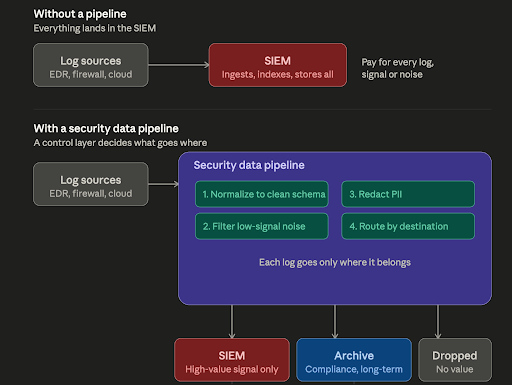
With a security data pipeline like Realm Security, there is a layer at the collection point between the log input sources (e.g., EDRs) and potential destinations, including the SIEM, data lake, etc. This data pipeline layer is where data is normalized and routed before it reaches the SIEM (if it reaches it at all).
The workflow before the SIEM is now:
- Data is normalized into a consistent structure first, so everything downstream (filtering, routing, and the SIEM itself) has clean, structured input to work from. Realm applies ML and LLM models across ingestion, filtering, and normalization, which is what lets AI correlation actually perform rather than choke on inconsistent, malformed logs.
- Detection value is determined and non-valuable logs are filtered out. Because the data has already been structured, the pipeline can remove low-signal telemetry before it reaches the SIEM, rather than ingesting everything and sorting it out later. Realm Security does this with AI-native filtering, which delivers 200% more data reduction than legacy filtering tools and a 50% to 70% reduction in data volume. This happens without breaking detections because filtering strategies are validated against a knowledge base of SIEM detection rules before any recommendation is applied. Core security events are untouched, with all fields intact.
- Sensitive data is protected in transit. Since every record has been parsed, PII can be identified and redacted before it lands anywhere it shouldn’t. Realm Privacy Guard does this so that PII is transformed before hitting the SIEM and never enters billable or searchable environments, covering GDPR, CCPA, PCI, and HIPAA automatically.
- Routing is done in tiers. Real-time security signal goes to the SIEM, while compliance and long-term data go to cheaper storage. Realm Data Haven can handle this natively (driving a 50% to 80% SIEM ingest cost reduction). History stays available for the breach and reporting timelines that stretch to a year or more, with flexible retention defaulting to one year and scalable to five or more, and authorized users are able to access full, un-redacted data via audited resupply from Data Haven.
The above workflow is totally automated and dynamic. It just happens in the background and adjusts to what you need your logs to do. This is modern log management designed to scale with your organization.
Modern SIEM log management brings as few logs to the SIEM as possible — without ever compromising your team’s ability to detect and respond.
See What Realm Would Do In Your Environment
A security data pipeline like Realm Security normalizes, filters, protects, and routes every log before it reaches your SIEM — so the SIEM stays lean, fast, and affordable.
Book a demo of Realm Security, and we’ll show you what modern log management could do for your SIEM, without replacing or rearchitecting your infrastructure.