TL;DR: SIEMs have become expensive, inefficient archives due to regulatory requirements, long breach detection times (avg. 241 days), and infrastructure sprawl. The problem: organizations pay premium SIEM pricing to store massive volumes of low-value logs (only 35% deliver real threat detection value), while exponential log growth creates budget overruns. Self-managed archives on cloud storage may seem cheaper, but they require painful custom integrations, complex resupply processes (2-4 weeks), and are often abandoned.
The solution: Route only high-value, actionable data to your SIEM for real-time detection. Archive everything else in a purpose-built system like Realm's Data Haven that handles compliance automatically, normalizes data on ingestion, and enables seamless resupply through guided retrieval (no custom queries or regex). This separates real-time security operations from long-term retention, cutting costs while maintaining investigative capability without the 2-4 week wait times.
The transformation of SIEMs from security tools to de facto archives didn't happen overnight. Several converging forces pushed organizations down this costly path.
Regulatory Complexity Drives Retention: The expansion of data protection regulations fundamentally changed the game. HIPAA demands six years of retention for healthcare organizations, Sarbanes-Oxley (SOX) requires seven years for financial records, and PCI DSS mandates at least one year with three months readily available. Faced with this regulatory maze, organizations defaulted to storing everything in their existing SIEM infrastructure rather than architecting purpose-built retention strategies.
The 200-Day Breach Reality: Modern cyber threats, particularly Advanced Persistent Threats (APTs), can lurk undetected in networks for extended periods. According to the 2025 Cost of a Data Breach Report, enterprise organizations take an average of 241 days to identify and contain a data breach. This sobering reality prompted security teams to retain logs for longer periods. Using the average of 241 days, a data retention window of six months would only help identify around 50% of data breaches.
SOC Consolidation and Infrastructure Sprawl: As organizations consolidated their security operations centers, SIEMs naturally became the repository for all security-related data. Simultaneously, the proliferation of cloud services, IoT devices, microservices, and remote work environments dramatically increased both the volume and variety of security data. This made centralized logging through a single SIEM platform attractive, as it eliminated the need for security teams to build and manage multiple, custom data pipelines for each source. Without a dedicated data platform, creating and managing a separate archive can seem daunting and cumbersome, making the singular SIEM solution appear to be the "easy button".
The Hidden Costs of Using a SIEM as an Archive
The financial burden of using SIEMs for long-term retention represents one of the most underestimated challenges in modern cybersecurity economics.
Sky-high prices for GBs and TBs: SIEM platforms have been notoriously expensive for decades, primarily because their pricing models directly tie expenses to data volume. According to the SANS 2025 SOC Survey, 42% of SOCs dump all incoming data into a SIEM, often without a retrieval or management plan. For enterprises ingesting terabytes daily, costs can reach millions annually. Driving up costs even higher, many SIEM vendors charge a premium for longer retention periods on top of the base volume pricing, making long-term storage "financially unsustainable". The practice of storing all logs for years on these platforms exacerbates this financial burden.
The Exponential Growth Problem: Log volumes continue to skyrocket year-over-year, continuously pushing organizations into higher pricing tiers and license overages. Survey data from Wasabi indicates that 62% of organizations exceeded their budgeted cloud storage spending in 2024, compared to 53% in 2023. This exponential growth compounds the pricing problem, creating budget overruns that force uncomfortable trade-offs between comprehensive logging and fiscal responsibility. In some cases, this leads to risky decisions like intentionally excluding entire data sources, such as firewall logs, to manage costs. This creates significant infrastructure gaps, hindering the SIEM's ability to make effective correlations and leaving organizations with security blind spots.
The Resupply Nightmare: While many organizations recognize the high cost of using a SIEM as a long-term archive, the alternative of self-managing a separate data storage solution is often just as painful. Some have attempted to save money by moving older logs to cheaper storage tiers on platforms like AWS, GCP, or Azure. However, this creates a new set of challenges that can make the process more trouble than it's worth.
Without a purpose-built solution, interoperability between a self-managed archive and the SIEM is cumbersome. Security teams must build and maintain their own connectors and write custom queries to pull data back in, all with little to no guidance. This process is complex and time-consuming, and it's difficult to pinpoint the exact data needed for an investigation, leading to situations where too much or too little data is resupplied. The resupply process itself can be expensive and take weeks.
For some organizations, the wait time for archived data to become queryable can be anywhere from 2 to 4 weeks. This reality, coupled with the hidden costs of data retrieval and complex billing structures, often leads security teams to simply skip the self-managed archive and revert to using the SIEM as their de facto data warehouse, despite the financial burden.
The Value Paradox: Here's the kicker: a 2025 Red Canary Survey finds that only 35% of data stored in legacy SIEMs delivers tangible value for threat detection. Organizations are paying premium prices to store massive volumes of noisy, low-value data that generates false positives and wastes analyst time. Meanwhile, the truly actionable security data gets buried in this haystack of historical logs.
Realm's Perspective: A Smarter Approach to Security Data
Realm believes that SOC teams should focus on what truly matters: actionable data in the SIEM for real-time threat detection. Everything else, the noisy, low-value data needed for compliance and long-term investigation, should be routed to a separate, cost-effective, and structured archive.
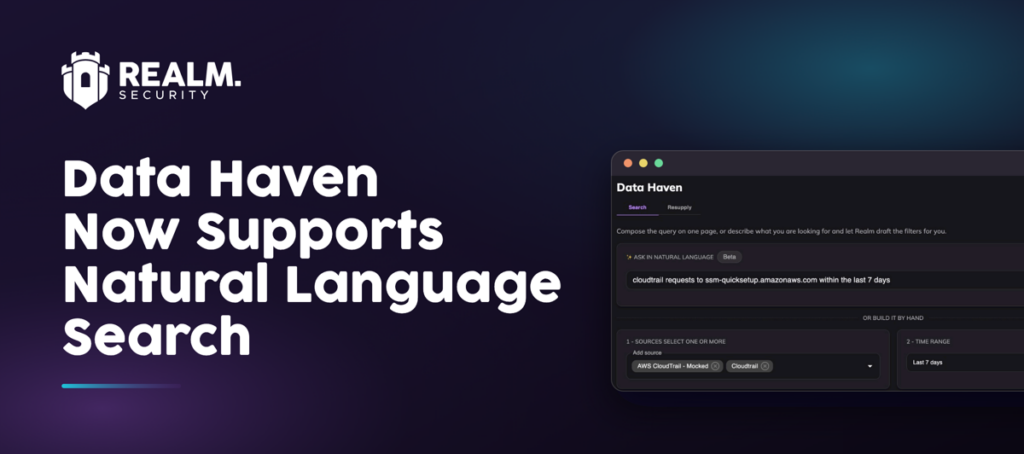
Realm’s Data Haven module offers a fundamentally different approach to this problem, transforming the archive from a cold, inaccessible repository into an active, analyst-friendly resource.
Realm enables you to:
Resupply Without Worry: With Realm, you can confidently filter and enrich data before it ever hits your SIEM. This allows you to route only the most valuable, security-relevant data for real-time detection, while the rest is archived. You don't have to worry about data gaps or incomplete investigations, as Realm is ready to resupply layers of context upon request from the archive.
Seamless Data Resupply: When a deeper investigation requires bringing archived data back into the SIEM environment, Realm handles the heavy lifting. You don't have to learn a new query language or write complex regex fields. Instead, Realm guides your retrieval by key elements of the data, such as IOCs, time ranges, and source products, without you having to write a single line of code or complex query. The data is automatically normalized across different tool formats, ensuring that retrieved logs integrate seamlessly with existing security workflows. This eliminates the compatibility and complexity issues that plague traditional archive solutions, making resupply a fast and straightforward process.
Normalize Data on Ingestion: All tools provide data in different formats, but Realm normalizes and structures archived logs from different sources. This ensures that when the data is retrieved, it's immediately usable for forensic analysis, eliminating the need for analysts to manually parse and clean raw logs.
Realm's Perspective: A Smarter Approach to Security Data
Your SIEM's primary purpose is to deliver real-time security. Its value is not in storing every log for years but in providing instant, actionable insights. By separating real-time data from long-term archives, you can optimize both functions without compromise.
This approach also fundamentally changes the painful resupply process. With Realm, you can eliminate the need for an analyst to submit a ticket and wait "2-4 weeks before the data can be queried". Instead of a costly and time-consuming process, resupply becomes a seamless operation. An analyst can supply a feed, a timeframe, and a machine name, and Realm easily resupply the SIEM. This means you can obtain the full context you need to investigate a security event, pulling from the archive and resupply only a small subset of the dataset into the SIEM. The data is already structured, normalized, and actionable, making it immediately ready for queries.
Realm's approach cuts costs, reduces the noise in your SIEM, and makes compliance effortless, all while empowering your security team to investigate faster and smarter. To learn more, schedule a demo of Realm.Security.