TL;DR: Cribl Detect is Cribl’s SIEM, launched in September 2026. Switching to it usually means migrating your detections, which Cribl says still need validation and tuning. For many teams, the better Cribl SIEM alternative is the SIEM they already have, with a security data pipeline in front of it.Realm, the SOC-aware security data pipeline, cuts the log volume you send to your current SIEM and checks the cuts don’t break the detections you rely on. Vensure cut FortiGate firewall log volume by 83%, saved $254,901 a year, and lost zero detections.Book a demo to see how much Realm would cut from your SIEM volume.
Cribl is best known as the pipeline that sits in front of SIEMs. It collects security telemetry, reduces it, and routes it on to whichever SIEM a team uses. In September 2026, Cribl announced its own SIEM, Cribl Detect, at its CriblCon conference.
If you’re looking at Cribl to lower your SIEM bill, your evaluation now includes a second question. Do you want to cut the cost of the SIEM you have, or move to a new one?
This article explains what Cribl SIEM is and what to consider if you use Cribl as your security data pipeline (or were planning to) now that it sells a SIEM too. It also covers why Realm doesn’t have a SIEM of its own, and why the SIEM you already have might be your best option.
What Is Cribl SIEM?
Cribl SIEM is Cribl Detect. Cribl calls Detect and the Cribl Platform together “the complete Cribl SIEM solution” and markets the launch as “a new way to SIEM.” Detect is a full SIEM that runs on embedded Cribl Stream and Cribl’s federated search.
Detect brings together two 2026 acquisitions. CardinalOps, announced in July 2026, brought detection engineering and detection posture management. Radiant Security’s AI SOC technology, bought in August 2026, brought AI triage and investigation.
Cribl’s Detect product page lists these capabilities:
- Detections that run in the pipeline while data is moving.
- Correlation that links single signals into slow-burn attacks.
- A catalog of more than 8,000 prebuilt detections.
- Detection Lab, an AI copilot for building, validating and tuning rules.
- Posture management covering ATT&CK maps, rule health and telemetry drift.
- Investigation across data wherever it lives, including other data lakes, object storage and other SIEMs, with no rehydration.
- Response through the ticketing, notification and SOAR tools you already use.
- Threat intelligence covering emerging CVEs and APT behaviors.
Cribl told TechTarget that Detect is “priced on the infrastructure it runs on, not on how much you search.” Cribl also says Detect delivers a complete SIEM “at up to 50% less cost.” We couldn’t find which SIEMs Cribl is comparing against, or anyone who has tested the figure.
As of this writing, Detect is only available to Cribl.Cloud customers. Cribl hasn’t released a self-managed or on-premises version. Cribl has said those options are under consideration.
To migrate detection content, Detect supports Sigma rules and assisted translation of Splunk detections. Cribl told TechTarget that migrated content still needs validation and tuning for the new environment.
Should Your Security Data Pipeline and SIEM Come From the Same Vendor?
Probably not. If you want a pipeline vendor that stays neutral about which SIEM you use, we do not recommend using the same vendor for your SIEM and security data pipeline.
Futurum notes that “much of Cribl’s value has come from neutrality.” Their Detect SIEM offer complicates that. Cribl now competes with the SIEMs it sends data to, and Futurum suggests watching whether Splunk, Microsoft, Google, and CrowdStrike keep treating Cribl as a partner.
On its Detect page, Cribl still offers running its pipeline next to your current SIEM, but as the option for when “immediate replacement isn’t practical.” It also says its SIEM is “designed to replace leading SIEMs.” If you use Cribl as your security data pipeline, you can probably expect it to make the case for Detect.
Cribl isn’t the only vendor combining a pipeline and a SIEM. CrowdStrike already sold a SIEM, and in August 2025 it agreed to acquire Onum, a data pipeline company, to filter data on its way into Falcon Next-Gen SIEM. Read our Onum vs Cribl vs Realm comparison.
Buying the pipeline and the SIEM from one vendor can make sense for some organizations. There’s one contract to manage and one support team to call. Some features also only work when the pipeline and the SIEM are the same product, like running detections on data while it’s still moving through the pipeline.
The downside is that the more you rely on those features, the harder it can become to separate the two later. If you’re okay with that trade-off, a combined platform could work for you. If neutrality matters more, keep the security data pipeline and the SIEM separate.
The Best Cribl SIEM Alternative Is Your Current SIEM With a Security Data Pipeline
Your current SIEM holds years of detection content and tuning, and your analysts know how to use it. Futurum calls moving the data “arguably the easier part” of a SIEM change, with detection content and tuning harder to move.
If cost is why you’re looking at Cribl Detect, you can cut the bill without switching SIEMs. Any security data pipeline, Cribl Stream included, can reduce what you send to your SIEM. Realm, the SOC-aware security data pipeline, can deliver 50 to 80% lower ingestion volume, and its Detection Integrity checks those cuts don’t break the detections you run.
Cost isn’t the only reason teams look at a new SIEM, and a pipeline can fix some of the others too. Two common ones are retention limits and sensitive data landing in the SIEM. Realm’s Data Haven keeps a raw copy of every connected source with no storage cap, and its Privacy Guard masks sensitive data in transit before it reaches the SIEM. If your analysts want a different SIEM to work in, a pipeline won’t fix that, and switching may be the right call.
Realm doesn’t sell a SIEM. That means Realm has no reason to push you toward one SIEM over another.
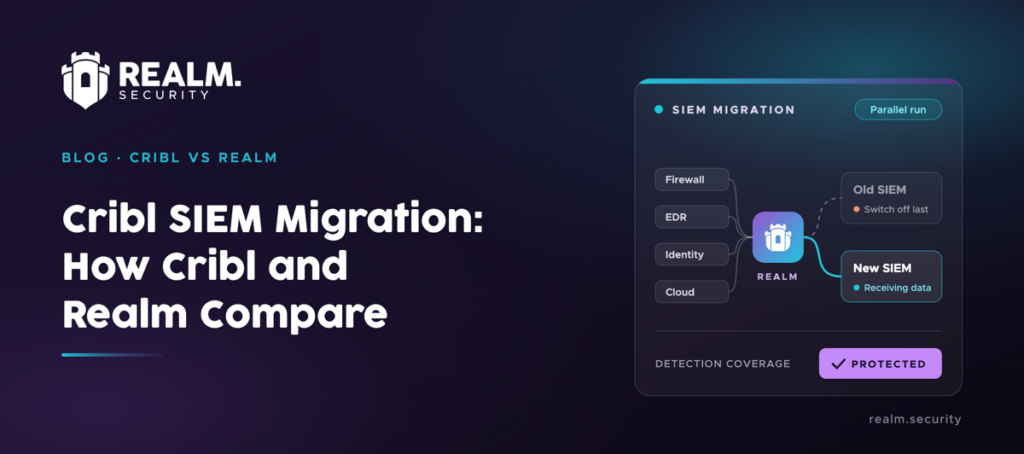
If you decide to switch SIEMs, Realm formats the same data the way each SIEM expects, so it can send data to your old and new SIEM while you move. Data Haven can also resupply past events to the new SIEM. Realm supports CrowdStrike Next-Gen SIEM, Exabeam, Google SecOps, Microsoft Sentinel, Cortex XSIAM, Securonix, Splunk and Sumo Logic. See our SIEM migration guide on how to switch SIEMs without compromising detection coverage.
How Realm Lowers the Cost of Your Current SIEM
You may not need a new SIEM, just a cheaper way to run the one you have. Realm reduces what you send to it without breaking the detections you rely on.
Realm finds what you can safely cut
Realm Clarity AI is the intelligence layer inside the Realm Platform. It profiles every source at field level and knows what each destination needs. It recommends rules for filtering, normalization, enrichment, routing, redaction and retention, and shows each rule’s projected impact on volume and cost. Rules run in a pending state against live data first, and nothing changes until you approve.
Realm protects the data your detections depend on
Detection Integrity is how Realm checks that cutting your SIEM log volume doesn’t break the detections you run. It reads the detections you run and maps each one to the log sources and fields it depends on, and to MITRE ATT&CK. It accepts any detection in text form, including Sigma, SPL, KQL, and CQL.
From that map, Realm builds protection rules for the data your detections use. When it can’t safely build one, it flags that detection as a finding instead of cutting. Rules appear roughly 48 hours after you upload your detections, and nothing applies until your team reviews and activates it.
Realm retains the data you cut, so you can search it later
Data you take out of your SIEM is still kept. Data Haven, the searchable retention layer of the Realm Platform, automatically keeps an immutable raw copy of every connected source, with OCSF-normalized observables attached.
You can search your full history in natural language or with a graphical query builder, then resupply only the events you need to any destination. Data Haven is priced on ingest, and search and resupply are unmetered.
Realm is live in about 7 days
Realm needs no code and no data engineers and is live in about 7 days.
Cribl Detect vs Your Current SIEM With Realm
If you’re still deciding, below are some of the situations where each makes sense.
Keep your current SIEM and add Realm if:
- You want a pipeline vendor that doesn’t sell a SIEM of its own.
- You want proof that cutting log volume won’t break the detections you run.
- You may switch SIEMs later and want to send data to your old and new SIEM while you move.
- You want a raw copy of every source kept automatically in an open format, and the option to resupply only the events you need to any destination.
- You need sensitive data masked in transit without changing its structure, so parsers and detections keep working.
- You don’t have data engineers to build and maintain pipeline rules, and want to be live in about seven days.
Choose Cribl Detect if:
- You already run Cribl on Cribl.Cloud and want your SIEM on the same platform.
- You plan to replace your SIEM and have the detection engineering time to migrate and tune content.
- You want detections to run in the pipeline while data is moving.
- You run a lot of searches and want a SIEM priced on infrastructure, not on search volume.
See What Your Current SIEM Could Cost With Realm
Cribl Detect gives teams a new reason to think about switching SIEMs. But before you do, we recommend you find out whether the problem is your SIEM or the amount of data you send it.
Vensure Employer Solutions used Realm to cut the FortiGate firewall log volume going into its Sumo Logic SIEM by 83%. It saved $254,901 a year and lost zero detections.
Book a demo to see how much Realm would cut from your SIEM volume.
Cribl SIEM FAQs
Short answers to common questions about Cribl SIEM and Realm.
Is Cribl a SIEM now?
Yes. Since September 2026, Cribl has sold a SIEM called Cribl Detect alongside its pipeline products.
Can I run Cribl Detect on-premises?
At the time of writing, no. Cribl Detect is available to Cribl.Cloud customers. Cribl has said self-managed options are under consideration.
Does Realm have a SIEM?
No. Realm is the SOC-aware security data pipeline that works upstream of the SIEM you already run.
Can I lower SIEM costs without changing SIEMs?
Yes. Many SIEMs charge for the data you send them, so reduce that volume. Realm can lower ingestion volume by 50 to 80%, and Detection Integrity protects the data your detections depend on.
What happens to the data Realm reduces?
Data Haven keeps a raw copy of every connected source. When an investigation needs older events, you search for them and resupply them to your SIEM or to any other destination.