TL;DR: The bottleneck in security data reduction was never generating candidate rules. It was evaluating them with enough context to trust the decision. Every reduction rule Realm recommends now ships with a Reduction Rule Assessment: the reasoning for why the rule is likely to be effective, and the considerations for where it might not be appropriate, generated from the actual conditions in the rule and written to be read in minutes. Detection Integrity checks every cut against the detections you actually run, and Data Haven retains what you reduce, so the judgment call that is left is the only part that still needs a human.
Every security engineer has had this moment. You are looking at a high-volume log source, a firewall feed, an EDR agent, a cloud audit stream, and you know most of it is noise. The SIEM bill says so, and so does the alert queue. The instinct is to cut it.
Cutting it is harder than it looks. Finding what to reduce takes minutes. Knowing whether a reduction is safe for your environment, your detections, and your compliance obligations is where the hours go. That evaluation is the real bottleneck in SIEM log reduction, and it is the part most tools leave to you.
Some teams start from scratch: a senior engineer or detection specialist pulls sample events, hypothesizes what is reducible, and writes exclusion rules by hand. Others use a pipeline platform that generates candidate rules from a template. Either way, the candidates are the easy part. The confidence to deploy them is what costs you.
Why reducing data is worth the effort
Reducing low-signal data is usually framed as a cost conversation. The downstream effects matter more than the SIEM bill.
Volume drives alert noise. Alert noise degrades the mean time to detect. And because you cannot respond to what you have not detected, slower MTTD compounds into slower MTTR. The SOC’s effectiveness moves backward one metric at a time, even when headcount and tooling hold steady.
Cutting low-signal, high-volume data breaks that chain. Fewer events mean fewer low-fidelity alerts, allowing analysts to spend more of their time on the alerts that matter. Volume is a proxy. Signal quality is the real target.
That is the upside. The reason these decisions are hard is the downside asymmetry: the cost of missing a real alert is almost always higher than the cost of keeping some noise. Every reduction is a decision you would rather not get wrong.
Realm narrows that asymmetry structurally, in two ways, before judgment ever enters the picture.
The first is Detection Integrity. Before Realm reduces a source, it reads the detections you actually run, maps each one to the log sources and fields it depends on, and protects that data. When it cannot safely build an exclusion for a detection, it flags that detection as a finding instead of cutting. The class of mistake where a reduction quietly starves a rule someone wrote eight months ago gets handled mechanically, not left to memory.
The second is Data Haven, Realm’s searchable retention layer. Data reduced out of the SIEM is retained there as a complete, immutable copy with OCSF observables attached, not deleted. If a reduction turns out wrong, you search your full history on the observable and resupply the exact events to whatever destination needs them. The decision is recoverable rather than a permanent blind spot.
What is left after those two is the part neither can decide for you: whether a reduction fits your environment, your threat model, and your compliance obligations. That is the judgment call, and it is where the hours go.
Why evaluation is the real bottleneck
Reducing data at scale would be straightforward if the only question were which detections touch which fields. That question has a mechanical answer. The harder one does not.
Every organization defines high-value data differently. A healthcare organization might subscribe to a financial services threat feed because its payment infrastructure shares a vulnerability surface with banking software. An industrial manufacturer might care about cloud identity logs because of a single third-party integration sitting in the middle of their OT environment. Generic guidance about what is safe to filter cannot reach that level of specificity, and it should not. Only someone inside the environment can make that call.
The detections you run today are only part of it. The question underneath a reduction is also what you would want available for the detections you have not written yet, the hunt you will run next quarter, and the incident review that asks why a specific event never made it to the SIEM.
That is why evaluation is real work. Doing it well on a single candidate rule means pulling packet captures, researching vendor-specific field semantics, reasoning about what compensating coverage you have, and double-checking against compliance requirements. Thirty minutes per rule is a reasonable floor. An hour is not unusual. Multiply that by eight candidate rules on a single data source, across a catalog of data sources, and the math gets uncomfortable fast. On a two-person SOC team where the same engineer writing exclusion rules is also on the on-call rotation, it becomes prohibitive.
The common workarounds do not scale. A dedicated detection engineering function with the right data background is expensive and hard to staff. A faster path, pasting log samples into a general-purpose LLM, trades speed for a different set of problems: enterprise log context going into models that were not built for security and privacy, and output quality that depends entirely on how well the prompt is written and how much domain expertise the practitioner brings to interpreting the response.
There is a compounding issue underneath both. Even when the evaluation work does get done, it rarely gets written down in a form that the next engineer can pick up. The context stays in one person’s head. The next time a similar rule shows up, on a new data source, after a vendor updates a log format, when a team member moves on, the work starts over. Documentation is a known weak spot on most security teams, and it is nowhere weaker than in the institutional knowledge around why specific events were, or were not, reduced.
What the Reduction Rule Assessment does
Every reduction rule that Realm recommends, whether from our library of rules built against common data sources or from the personalized rules generated against the specific patterns in your environment, now ships with a Reduction Rule Assessment.
The assessment comes from Realm Clarity AI, the intelligence layer inside the Realm Platform. Clarity AI reasons over two things: what your sources produce, and what each destination needs. It understands the data and shapes the rules. The Platform executes them, and only after you approve. Nothing changes on its own.
The assessment has two parts, explicitly separated.
Reasoning
Reasoning explains why this rule is likely to be effective against this data source and rule pattern. What class of events it targets, what makes them low-signal, and the security rationale for suppressing them.
Considerations
Considerations explain where the rule might not be appropriate. What compensating detections matter, what an environment needs to look like for the reduction to be safe, and what to verify before deploying. This is the side most AI-generated recommendations leave out.
Both are written in plain English. Both are generated from the actual conditions defined in the rule, not from a generic description of the rule’s category. That distinction is the whole difference between guidance tuned to your configuration and a template with your source name on it.
The assessment stays current with the landscape. What is true about data exfiltration patterns today may not hold in six months, as attacker behavior shifts and vendors update log formats. The assessment updates to reflect that.
None of this replaces practitioner judgment. The point is to collapse the research cycle, the captures, the vendor documentation, the compensating-control analysis, into something a senior engineer can read and act on in a couple of minutes. The decision still belongs to the person who knows the environment.
What this looks like in practice
Two example rules show what that reads like.
The first is “Authorized UTM messages,” generated against FortiGate firewall data. The conditions suppress UTM events where the subtype is application control, the action is “pass,” and no client reputation level is set.
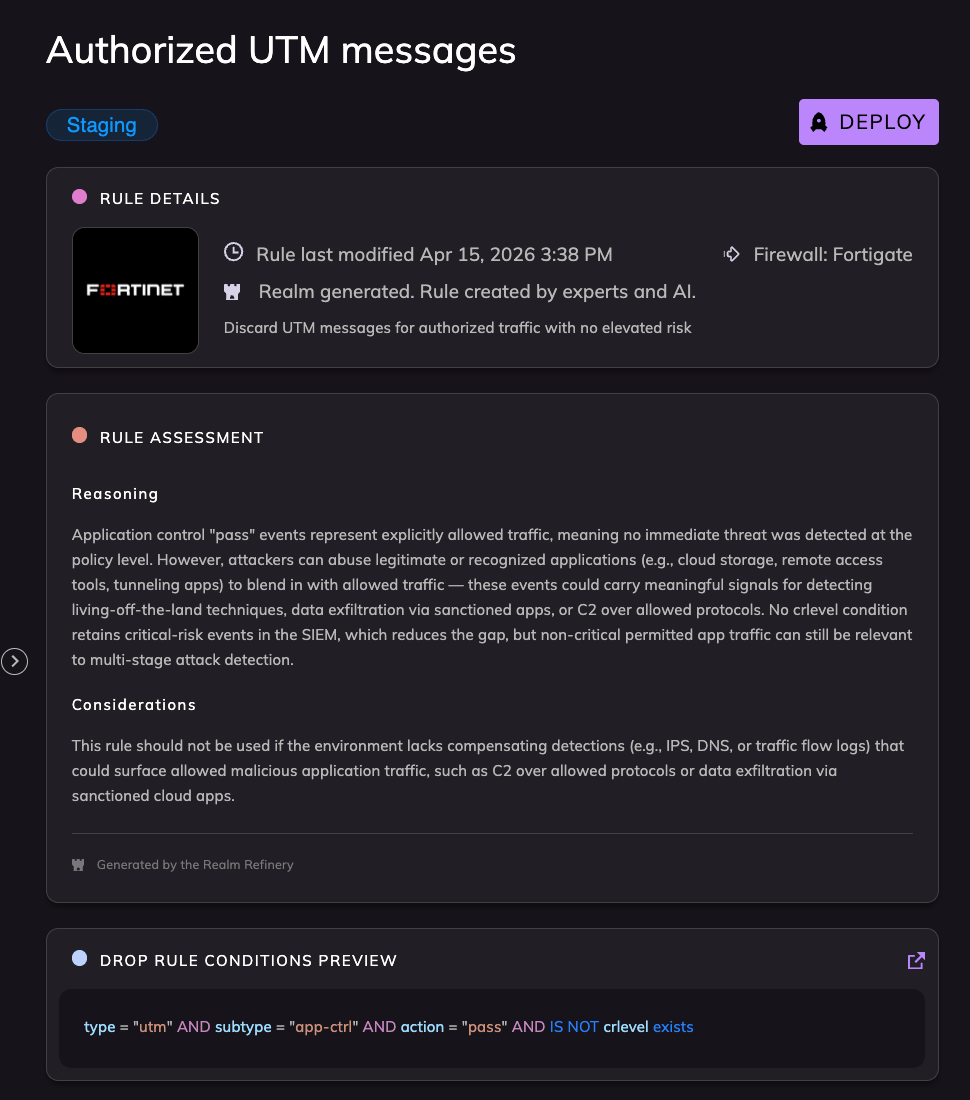
The Reasoning explains what these events represent: explicit application-control passes, where the firewall has already determined no immediate threat at the policy level. As a class, that traffic is high-volume and low-signal, a textbook reduction target.
The Considerations explain where the picture changes. Attackers routinely abuse sanctioned applications, cloud storage, remote access tools, tunneling apps, to blend into allowed traffic. Living-off-the-land techniques, data exfiltration through approved SaaS, and C2 over permitted protocols can all surface inside the events this rule suppresses. The rule’s existing carve-out for critical-risk events narrows the gap but does not close it. Detection integrity has already protected the fields your live detections depend on. What is left is the coverage question that sits outside them: whether the environment has IPS signatures, DNS telemetry, or flow logs that can surface allowed-but-malicious activity nothing is currently written to catch.
The second is “Discard top DNS domains from Majestic Million,” generated against Cisco Umbrella data. The rule excludes successful DNS resolutions to the top 5,000 FQDNs in the Majestic Million list.
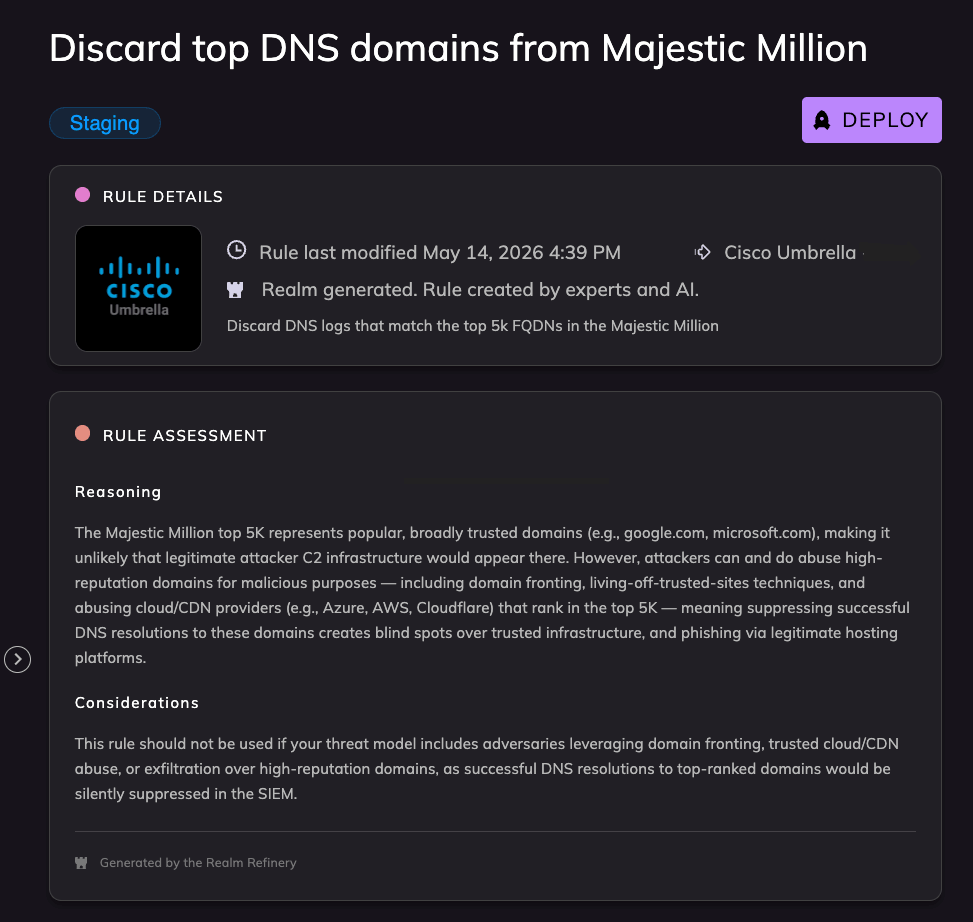
The Reasoning explains the underlying logic: top-ranked domains are popular, broadly trusted, and unlikely to host attacker C2 infrastructure. The volume of resolutions to google.com, microsoft.com, and the like is enormous, and the signal-to-noise on that traffic is low.
The Considerations push back on the obvious read. Adversaries do leverage high-reputation domains, through domain fronting, living-off-trusted-sites techniques, and abuse of cloud and CDN providers that themselves rank in the top 5K, including Azure, AWS, and Cloudflare. Suppressing successful resolutions to those domains creates blind spots over exactly the infrastructure most worth watching. Whether the rule fits depends on the threat model. An environment where domain fronting and trusted-CDN abuse are not realistic concerns can deploy it confidently. One where they are can keep the data out of the SIEM and retain it in Data Haven instead, so the volume comes off the bill and the events are still searchable when a hunt needs them.
That is the distinction a practitioner needs to make. It would otherwise take thirty to sixty minutes of research per rule. The assessment surfaces it in a paragraph.
What changes when evaluation gets faster
Three things move.
The first is realized reduction. Pipelines generate value when rules get deployed, not when they sit in a review queue. A team that can evaluate a recommendation in minutes instead of an hour deploys more rules, captures more reduction, and sees faster payback on the pipeline investment. The gap between potential and realized reduction is almost entirely an evaluation-throughput problem. Vensure cut 83% of their FortiGate firewall log volume and saved about $254K a year, with zero detection gaps.
The second is coverage you can show rather than assert. Reducing data without enough context creates silent blind spots, the kind that do not surface until an incident review asks why a specific event never made it to the SIEM. Realm closes that loop at both ends. Explicit Considerations make the risk legible before a rule is deployed. After it is deployed, the detection integrity report shows what was reduced, what was protected, and your MITRE ATT&CK coverage, on your own data, in a report you can hand leadership, audit, or an examiner. Every pipeline can cut volume. Proving the cut did not cost you a detection is the part a black box cannot do.
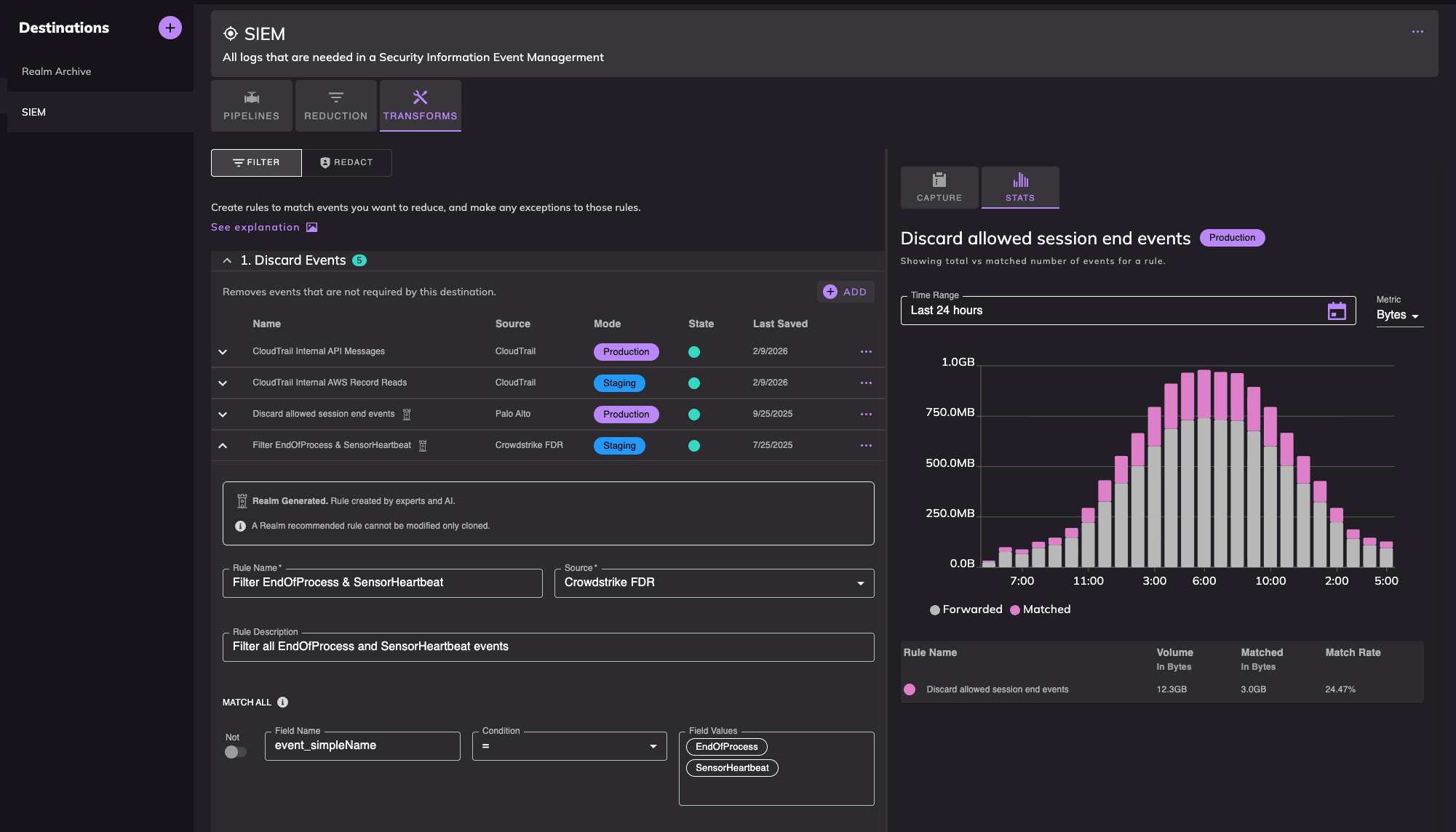
The third is senior engineer time. Evaluation work currently falls on the same people who should be building detections, running hunts, and improving IR readiness. Collapsing the research cycle gives that time back.
It also changes who can do the work. A data engineer who owns the pipeline but lacks full detection context, or a junior analyst learning the environment, can use the assessment as a starting point and bring evaluations to senior review with the trade-offs already mapped.
Closing the evaluation gap
The bottleneck in security data reduction was never generating candidate rules. It was evaluating them with enough context to trust the decision.
Realm closes that gap in three layers. Detection integrity checks every cut against the detections you actually run. Data Haven retains what you reduce, searchable and ready to resupply. The Reduction Rule Assessment gives you the reasoning and the considerations for the judgment call that is left, written to be read in minutes and kept current as the landscape changes.
Detection Integrity
Checks every cut against the detections you actually run.
Data Haven
Retains what you reduce, searchable and ready to resupply.
Reduction Rule Assessment
The reasoning and the considerations for the judgment call that is left, written to be read in minutes and kept current as the landscape changes.
Realm’s recommendations are there to be evaluated, not deployed on autopilot. The team still owns the decision, and the assessment is what lets them own it with their eyes open. The pipeline is yours. The detections are yours. The decisions should be, too.
If you want the upstream mechanics, how Clarity AI generates reduction rules in the first place, the earlier post on filtering rule recommendations covers that ground.
Realm is the SOC-aware security data pipeline. If you would like to see the Reduction Rule Assessment against your own data sources, request a demo and we will walk you through it.